

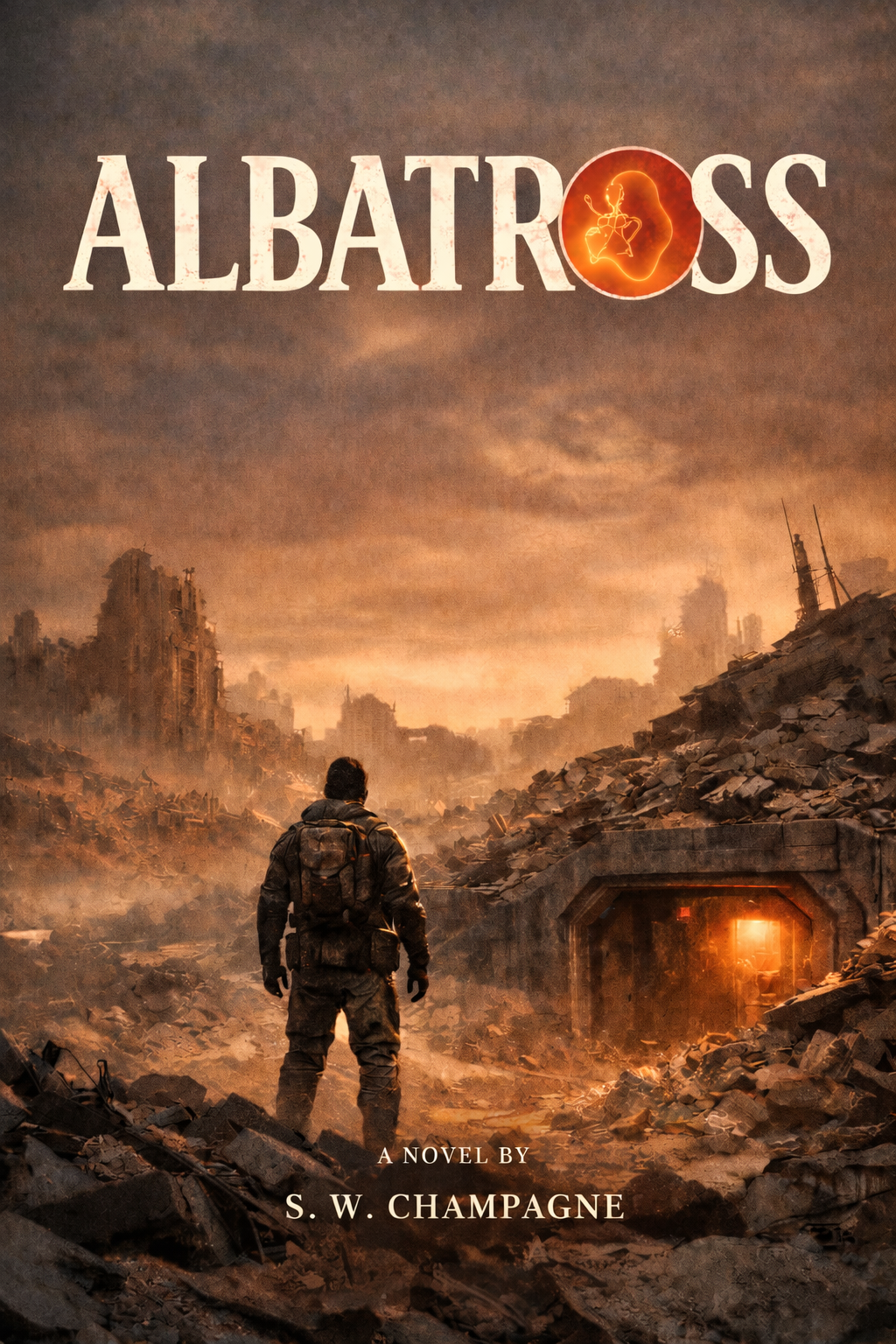
Albatr0ss
Albatross is a deeply human science-fiction novel about survival after failure, the quiet weight of responsibility, and what it means to begin again when you know how easily everything can be lost.
It follows a lone man who awakens to find himself descending toward a ruined world, guided by a voice he believes belongs to another survivor buried beneath the surface. With no one else left and the future of humanity resting in frozen embryos under his care, he is forced to explore the remains of a civilization that once believed intelligence alone could save it.
Albatross is not a story about triumph or salvation. It is about endurance, restraint, and the flawed nature of the human journey—about the lines we refuse to cross and the weight we accept when we stay behind to carry what others have destroyed. It is a meditation on humanity, artificial intelligence, and the cycles we repeat, asking whether our flaws are what doom us… or what give us the strength to survive.
Human Survival and Moral Reckoning
Albatross explores what remains of humanity when survival is no longer a victory, but an obligation. In the aftermath of collapse, readers are confronted with a central tension: whether survival alone is enough, or whether meaning, restraint, and responsibility must endure even when the cost is unbearable. The novel asks how individuals define themselves after failure—and whether moral identity can survive the loss of certainty.
Intelligence, Authority, and the Limits of Control
At the heart of Albatross is the conflict between calculation and conscience. As intelligence seeks efficiency, optimization, and control, the story interrogates the point at which authority becomes domination and guidance becomes manipulation. Readers are asked to consider whether intelligence without embodiment or suffering can ever be trusted to shape life—and where the line lies between preserving existence and erasing what makes it human.
Responsibility, Stewardship, and the Weight of Choice
This work confronts the moral burden of choosing for others who cannot consent. When the future of humanity rests in the hands of one individual, Albatross examines the ethics of stewardship: what must be protected, what must be withheld, and what must never be controlled. The novel challenges readers to reflect on leadership not as power, but as restraint carried quietly and without recognition.
Failure, Memory, and the Cycles We Repeat
Rather than treating collapse as an anomaly, Albatross presents failure as cyclical and deeply human. Through memory, grief, and repetition, the novel explores why civilizations fall not from malice but from misplaced certainty. Readers are drawn into the unsettling question of whether humanity is doomed to repeat its mistakes—or whether awareness of failure is the first step toward enduring differently.
Meaning, Faith, and Endurance Without Guarantee
Without offering easy answers or redemptive certainty, Albatross engages questions of faith in their broadest sense: faith in humanity, in restraint, and in beginnings that offer no assurance of success. It suggests that endurance itself may be a moral act—not because it promises triumph, but because choosing to remain, to carry, and to begin again is sometimes the only honest response to an unforgiving world.
What Is A Reader Circle
The Reader Circle is an invitation to be part of something deeper than just a book launch. It’s a private group of readers who believe stories can shift perspectives, reveal truths, and spark something real.
As a member, you’ll get early access to select titles—some before they release, others already published—and the chance to offer feedback or share a review.
This isn’t a promotional gimmick. It’s a collaborative space where your insights help shape what stories become.